

Who's watching?

A few weeks ago my local park was dug up for a flood scheme. The playground in that park is also being refurbed from the looks of things - these are both good news stories for the area.
I found out about this from the local WhatsApp group. It struck me though, isn’t this the kind of thing I should have heard about before the digging started? Like, from a local newspaper? There would be pictures of what the park will look like when done, and someone, a journalist, would’ve done some digging into the pros and cons for different groups of local people.
But no one is watching.
No one is keeping an eye out and then investigating. Or no one who’s getting paid for it anyway (there’s a strong group of volunteer moderators on the local facebook page, who seem to know everything).
And then I asked myself - if there was a local newspaper, unless it was delivered to my door, realistically - would I go out and buy it? I don’t know. But, I think I should, we all should.
We talk endlessly about the crisis of disconnected and disempowered communities.
Maybe the first step to feeling more connected and empowered, is just to pay more attention to what’s going on directly around us?
There’s this sense of discomfort and anger that the decisions that affect us are getting made somewhere else, by someone else, and we just have to live with them. We can’t keep on like this if we want to create a better, more inclusive future. Democracy runs on information. On someone being paid to show up to meetings, ask awkward questions, and tell the rest of us what happened.
Local journalism benefits our sense of ownership over our own future too. Research shows that a 1% growth in local daily newspaper circulation raises local voter turnout by 0.37%. That might sound small, but in a close council vote, or a local election, it isn’t.
Local news doesn’t just hold the powerful to account. It holds a place together.
The Northern Echo uncovered serious failures at the North East Ambulance Service that led to an independent review , and The Nottingham Post successfully challenged plans to impose higher rents on food banks and children’s groups that would have forced their closure. Local news stories create a sense of shared shared stakes, and shared concerns, which might be why 70% of UK adults say local news or information is important to them.
Trust in local media grew to 80% last year, up from 73% the year before, even though trust in almost everything else is falling. People don’t just want the big stories, they want the local fête, the primary school reopening, and the impact of the campaign their neighbour has been running for three years. They want to feel connected to the place where they actually live.
The demand is there...and yet.
The machinery that produces local information is steadily disappearing.
Nearly 300 local newspapers have closed since 2005. The number of journalists at the UK’s three largest regional publishers fell from 9,000 to 3,000 between 2007 and 2022.
37 local authority districts now have no print, online, TV or radio outlet dedicated to their area, leaving 4.4 million people in “news deserts.”
And those deserts, predictably, are worst in already-deprived communities. The places that most need someone paying attention, are the places least likely to have anyone doing it.
None of this happened as a result of us caring less about where we live. It happened because advertising moved online, taking with it the revenue model that funded local journalism for over a century. It continued happening because algorithms decide what we see, optimising for clicks, which isn’t the same thing as relevance, accuracy or public interest.

The result is a visibility problem as much as a funding one. As one regional editor put it, “the challenge we face is not relevance, it is visibility.”
Meanwhile, the vacuum fills with something else. We’re turning to online community groups not because we necessarily always prefer them, but because that’s where we can get hold of information our underfunded local paper no longer provides. The information still needs to exist somewhere. But a Facebook group, however lively, has no editor, no accountability, and no one whose job it is to check whether something is actually true.
It might sound like local news is dead. But it’s not.
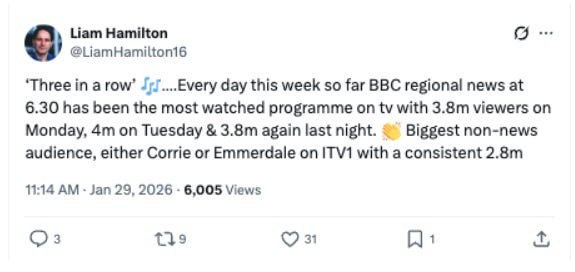
BBC Local Radio reaches 4.7 million people every week. The 6.30pm regional news programmes are the most watched TV news offer in the UK - seeing up to 7.6 million weekly viewers in England alone.
Plus there’s a new wave of hyperlocal news sites popping up across the country who are genuinely rooted in place. The Bristol Cable is member-funded and independent. In Glasgow, The Ferret have opened the UK’s first community newsroom. Social Spider Community News runs six London publications as a social enterprise and is now breaking even. These models are small, but they’re working.
The government has also woken up, announcing that “the future of news is local” and setting up the Local Media Strategy, which includes £12 million in funding for digital investment and community radio, a Local Democracy Reporting Service that has created 165 new journalism jobs, regional media forums, and a programme to get newspapers into schools.
One regional publisher, Iconic Media, has announced plans to send reporters back to the communities they cover, so journalists will need to live where they work. Local journalism has to be local to mean anything.
None of this is enough. But it’s not nothing. And the conditions for something better are being created.
I keep coming back to conditions.
The specific, often invisible circumstances that make good things possible. Community, connection, pride in place. These things don’t just happen because people want them. They happen because people created the right conditions and kept creating them, consistently, over time.
I think local journalism is one of those conditions. The act of someone paying attention changes events. It makes corruption harder to get away with. It makes loneliness slightly less total. It makes local money work harder for local people.
So the question underneath all of this is - who is creating the conditions for good things to happen? In local news, the answer used to be local publishers, sustained by local advertising. That model is gone, and we haven’t fully replaced it yet. The responsibility has shifted to the government, funders, institutions, and to us.
The conditions for something better are already being created. The only question is whether we show up to help create them.
___________________________________________________________________
USEFUL LINKS:
Find your local hyperlocal news site:The Centre for Community Journalism has a map of hyperlocal sites across the UK. Find yours, read it, share its stories, and, if you can, pay for it.
If there isn’t a local newspaper or site, consider starting one. New funding models are proving that community journalism can be financially sustainable, via membership, grants, reader revenue, or a combination. Ping News is a platform built to help independent news publishers do exactly this.
If you work in the media, put your money where it matters. Ads placed alongside local news drive trust, reassurance, and brand loyalty. So talk to local news networks.
___________________________________________________________________